
A fridge in an unheated garage in Toronto, Ontario, runs into trouble in winter because the cold stops the compressor from running often enough, and a garage ready fridge is only rated down to about 3°C. This guide is for homeowners who keep a fridge or fridge-freezer in the garage. It explains why the freezer thaws while the garage is freezing, why water ends up on the floor, what to do before winter and when to move or replace the unit. It matters because a garage fridge can spoil a freezer full of food without any warning.
Key Takeaways
- Toronto’s 1971–2000 average daily temperature in January is -6.3°C, well below what any household fridge is rated for.
- In a cold garage the compressor runs too little, so the freezer warms up and food thaws.
- Below 0°C the fridge compartment freezes fresh food and the defrost drain ices up and leaks.
- Garage ready models are commonly rated from 38°F to 110°F (about 3°C to 43°C). That covers a cool garage, not a frozen one.
- Before winter: disconnect water lines, inspect the door gaskets and check the unit’s minimum ambient temperature rating.
How Cold a Toronto Garage Gets
Standard indoor refrigerators are designed to run in climate-controlled environments. An unheated garage is not one. Environment Canada’s climate normals, as published by Statistics Canada, put Toronto’s 1971–2000 average daily temperature at -6.3°C in January, -5.4°C in February and -2.9°C in December.
Those are averages across day and night. An uninsulated, detached garage follows the outdoor temperature closely, so it sits below freezing for much of the winter and drops further overnight. An attached, insulated garage stays warmer, but few stay at room temperature.
Identifying the lowest ambient temperature of a garage is important before you decide anything about the fridge in it. A min/max thermometer left on a shelf for a cold week gives you that number.
Why a Fridge Fails in a Cold Garage
Most homeowners expect a cold garage to help a fridge. The opposite happens. These are the three faults we find most often on winter calls.
The Freezer Thaws While the Garage Is Freezing
In many fridge-freezers, one thermostat controls the compressor, and it sits in the refrigerator compartment. It switches the compressor on when that compartment warms above its setting.
When the garage cools to around fridge temperature, the compartment never warms up. The thermostat is satisfied, so the compressor rarely starts. The freezer has no cooling of its own. It depends on the compressor running, and without it the freezer drifts up toward the temperature of the garage. A garage at 2°C is cold to stand in and far too warm for frozen food.
Very cold surroundings can prevent proper freezer operation, and the result is a freezer of soft, thawed food in a garage that feels like a cooler. Temperature fluctuations can lead to spoilage or thawing of frozen foods in standard fridges, and food that thaws and refreezes unnoticed is not safe to rely on.
Fridge and Freezer Compartments Disagree
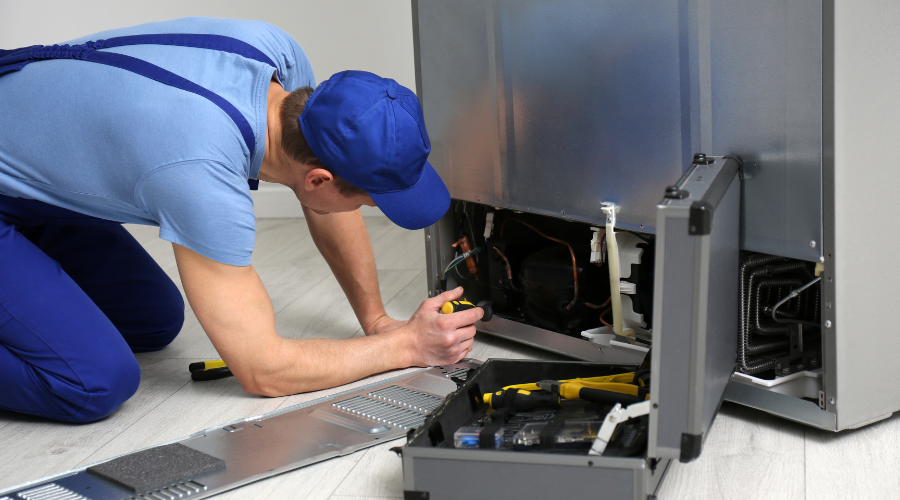
Once the garage drops below 0°C, the fridge compartment follows it down. Insulation slows the change but does not stop it, and a fridge has no means of heating its fresh food section. Drinks, produce and dairy freeze. Cans and bottles can split.
At the same time the freezer may still be too warm, because the compressor is not being called. So the two compartments end up wrong in opposite directions: fresh food frozen, frozen food soft.
The Defrost Drain Freezes and Leaks
A frost-free fridge melts the frost off its cooling coil several times a day. The meltwater runs down a drain tube to a pan under the unit, where it evaporates.
In a freezing garage that water turns to ice inside the tube or in the pan. The next defrost has nowhere to drain, so water backs up. It pools in the bottom of the freezer or fridge compartment, freezes into a sheet, or runs out under the door and onto the garage floor. Water under a garage fridge in winter is very often a frozen drain and not a failed part.
Any water line feeding an ice maker or water dispenser is exposed to the same cold. A frozen line can split and then leak when it thaws.
What Garage Ready Means in Winter
Garage-ready refrigerators feature specialized components to function when standard units fail. Their controls are calibrated for a wider range of surrounding temperatures, and some have a setting for cooler rooms that keeps the compressor cycling.
Garage-ready fridges operate between 38°F and 110°F, which is about 3°C to 43°C. Standard fridges have a narrower range that varies by manufacturer, and the owner’s manual gives the figure for your model.
The important number for Toronto is the bottom one. Three degrees above freezing covers a cool garage in October or an insulated garage in January. It does not cover an unheated garage at -6°C. A garage ready label widens the range. It does not make a fridge winter-proof.
What to Do Before Winter
- Check the unit’s minimum ambient temperature rating in the owner’s manual.
- Disconnect and drain the water line to any ice maker or water dispenser, and switch the ice maker off.
- Inspect the door gaskets. Rubber stiffens in the cold, and a gasket that no longer seals lets frost build up inside.
- Put an appliance thermometer in each compartment and check it weekly. Health Canada advises keeping the fridge at or below 4°C and the freezer at -18°C. Consistent internal temperatures are crucial to prevent spoilage and preserve food quality.
- Keep the fridge away from the garage door and off an exterior wall where you can.
Adapt, Move or Replace
The right choice depends on how the garage is insulated, the age and design of the fridge, and what is stored in it.
When the Fridge Can Stay
If the garage is attached and insulated, and your thermometer shows it stays inside the fridge’s rated range all winter, the unit can stay where it is. Keep the thermometers in place and check them after every cold snap.
When to Move It Indoors
If the garage drops below freezing, move the fridge to a basement or another heated room for the winter. If that is not possible, empty it, unplug it, dry it out and prop the doors open until spring. A fridge holding drinks is a small loss if it misbehaves. A freezer holding months of meat is not, so frozen food is the first thing to move indoors.
When to Replace It
Replacement makes sense when the fridge is old, has warmed and refrozen through more than one winter, or has an ice maker and water dispenser that cannot be protected from the cold. If you replace it, choose a model whose rated range covers the lowest temperature you measured in the garage.
When to Call a Technician
Call for service when:
- The freezer stays warm after the fridge has been moved into a heated room for 24 hours
- Water keeps appearing under the unit after the drain has had time to thaw indoors
- The compressor clicks on and off without running
- The fridge has stopped completely, with no light and no sound
Toronto Appliance Repairs provides refrigerator repair in Toronto and freezer repair in Toronto 24 hours a day, 7 days a week, with a 90-day warranty on repairs.
Frequently Asked Questions
Why does my garage fridge freezer thaw when it is cold outside?
In many fridge-freezers the thermostat that runs the compressor sits in the fridge compartment. When the garage is as cold as the fridge setting, the thermostat stops calling for cooling and the compressor barely runs. The freezer depends on the compressor to stay frozen, so it warms up and the food inside begins to thaw.
Can I keep a fridge in an unheated garage through a Toronto winter?
Not reliably. Toronto’s 1971–2000 average daily temperature in January is -6.3°C, and household fridges are not rated to run in freezing surroundings. The freezer can thaw, fresh food can freeze and the defrost drain can ice up. Move the fridge to a heated room for the winter, or empty and unplug it until spring.
Will a garage ready fridge work in a freezing garage?
Only while the garage stays within its rating. Garage ready fridges are commonly rated from 38°F to 110°F, and 38°F is about 3°C. That suits an insulated or lightly heated garage. An unheated garage in a Toronto winter falls below freezing, which is outside the range, so the same faults can appear.
Why is there water under my garage fridge in winter?
The most common cause is a frozen defrost drain. Meltwater from the defrost cycle normally runs through a tube to a pan under the fridge. In a freezing garage the tube ices up, the water backs up inside the cabinet and then leaks out. A split water line to an ice maker is the other likely cause.
Garage Fridge Not Holding Temperature? Call Us
If the freezer is thawing, fresh food is freezing or there is water under the unit, have it checked before more food is lost. Toronto Appliance Repairs offers refrigerator repair in Toronto 24 hours a day, 7 days a week, with a 90-day warranty on repairs.
Call 416-918-2700 to book.