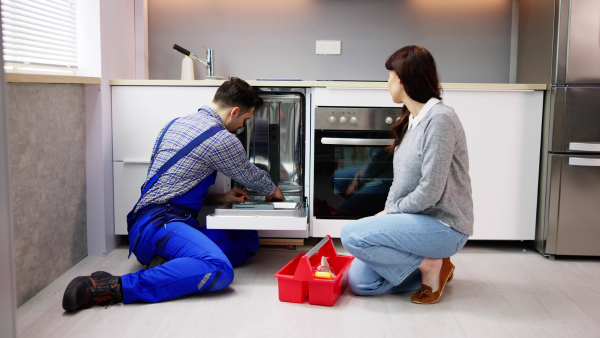
Commercial dishwasher temperature rules in Ontario come from the Food Premises Regulation, O. Reg. 493/17. It calls for wash water between 60°C and 71°C, then a sanitizing rinse of at least 82°C for 10 seconds or an approved chemical sanitizer. Machines certified by NSF are exempt from those figures and run to their own data plate. This guide is for Toronto restaurant owners, kitchen managers and anyone who runs a dish machine. It covers the numbers, how high and low temperature machines differ, why machines miss their targets, what to check each shift and when to stop and call for service. It matters because dishes that were never sanitized are a food safety risk and an inspection problem. Toronto Appliance Repairs services commercial dishwashers across Toronto.
Key Takeaways
- The Ontario regulation that covers dishwashing in food premises is O. Reg. 493/17, enforced in Toronto by Toronto Public Health.
- Its figures for mechanical equipment are a 60°C to 71°C wash and either an 82°C rinse for at least 10 seconds or a chemical sanitizing rinse.
- Chemical strengths in Ontario are at least 100 ppm chlorine, at least 200 ppm quaternary ammonium or at least 25 ppm iodine.
- Section 20(2) exempts NSF-certified commercial dishwashers. A certified machine is judged against the wash, rinse and sanitizer values on its data plate.
- The faults we find most often are limescale on heating elements, burned-out booster heater elements and low incoming hot water temperature.
- If you cannot confirm the sanitizing step, stop using the machine and switch to manual sanitizing or single service articles until it is repaired.
What the Ontario Regulation Says
Toronto Public Health inspects food premises against the Ontario Food Premises Regulation. The dishwashing requirements for mechanical equipment are in section 20 of O. Reg. 493/17.
The Section 20 Figures
For a mechanical dishwasher, the regulation sets out:
- Wash water between 60°C and 71°C (140°F to 160°F)
- A sanitizing rinse of hot water at 82°C (180°F) or hotter for at least 10 seconds, or
- A sanitizing rinse of chemical solution: chlorine at least 100 ppm, quaternary ammonium at least 200 ppm or iodine at least 25 ppm
The purpose is to sanitize dishes, utensils and other multi service articles so that food contact surfaces are safe for the next customer. Clean dishes that were washed but never sanitized do not meet the rule.
The NSF Exemption in Section 20(2)
Section 20(2) says those requirements do not apply to commercial dishwashers that are NSF certified. Operators often miss this, and it changes which numbers apply to their machine.
NSF/ANSI Standard 3 is the performance standard for commercial warewashing equipment. A machine certified to it has been tested to deliver a 5-log, or 99.999%, reduction of bacteria when it runs to the manufacturer’s specifications. Those specifications are printed on the data plate fixed to the machine.
In practice:
- If the machine carries an NSF mark, its data plate is the standard. Run it to those figures.
- If it has no NSF certification, the section 20 figures apply directly.
- If the data plate is missing or unreadable, get the specification sheet from the manufacturer by model number.
- If you are unsure which rule applies, ask your public health inspector before the next inspection.
A domestic dishwasher is not built or certified to the commercial standard.

Commercial Dishwasher Types and Their Temperatures
Commercial dishwashers are classified as high-temperature or low-temperature machines. Sanitization methods in commercial kitchens include high-temperature sanitization and chemical sanitization, and the type decides which readings matter.
The data plate figures on certified machines follow the same pattern as the FDA Food Code. Commercial dishwasher temperatures and methods are regulated by health codes like the FDA Food Code in the United States. The figures below come from that code. In Ontario they apply through the data plate of a certified machine, not as a separate legal requirement.
High Temperature Commercial Dishwasher
High-temperature machines sanitize using heat, not chemicals. A high temperature commercial dishwasher has a tank heater for the wash water and a booster heater that lifts the final rinse.
- High-temperature wash cycles operate between 150ºF to 165ºF (66ºC to 74ºC), depending on the machine type.
- The final rinse for high-temperature machines should be at least 180ºF (82ºC). High-temperature dishwashers must reach 82°C for sanitization under section 20 as well.
- One exception exists in the Food Code. A stationary rack, single temperature machine washes and rinses at the same temperature, and for that design the minimum sanitizing rinse temperature is 165°F (74°C).
- Dishwasher rinse temperatures should not exceed 194ºF (90ºC). Water that hot flashes to vapour before it wets the dish.
- Dishwasher sanitization requires a surface temperature of 160°F (71°C). High-temperature dishwashers achieve sanitization at 160ºF plate surface temperature, which is why the rinse water has to be hotter than the target.
Across the wash and rinse cycles, high-temperature dishwashers operate at 150ºF to 180ºF.
Low Temperature Commercial Dishwasher
Low-temperature machines rely on chemical sanitization like chlorine. A low temperature commercial dishwasher has no booster heater. It injects sanitizer into the final rinse.
- The wash cycle temperature for chemical-sanitizing dishwashers must be at least 49°C (120°F) under the Food Code. Low-temperature dishwashers operate at a minimum of 120ºF.
- Low-temperature rinse temperatures range from 24°C to 49°C, depending on the sanitizer used.
- Chlorine sanitizer requires a concentration of at least 100 ppm at a water temperature of at least 24°C.
- Iodine sanitizer requires a concentration of at least 25 ppm.
- Quaternary ammonium sanitizer requires at least 200 ppm at a temperature of at least 24°C, used as the product label directs.
Ontario’s section 20 figures are at least 100 ppm chlorine, at least 200 ppm quaternary ammonium and at least 25 ppm iodine. For a machine that is not NSF certified, use those figures. For a certified machine, use the concentration on the data plate and the chemical supplier’s label.
A certified low-temperature machine that washes at 49°C is not failing Ontario’s 60°C figure. It is meeting its own certified specification.
Why a Dish Machine Misses Its Temperature
<!– [CLIENT TO CONFIRM] The sentence below lists machine types (undercounter, door-type, conveyor, single-tank, multi-tank, glasswashers, pot and pan washers) that go beyond “Dishwashers” on TR’s commercial page. Confirm TR services all of these before publishing. –>
We service undercounter, door-type and conveyor machines, both single-tank and multi-tank, in high and low temperature versions, along with glasswashers and pot and pan washers. Across all of them, three faults account for most of the low readings we find.
Limescale on the Heating Elements
Scale from hard water coats the heating elements in the wash tank and the booster. It acts as insulation, so the element draws full power while the wash water stays cool. Scale also narrows the rinse nozzles and lowers the pressure at the rinse arms, so the water that does reach temperature covers less of the rack. Descaling on the manufacturer’s schedule is part of temperature compliance, not an optional extra.
Burned-Out Booster Heater Elements
The booster heater takes hot water from the building and raises it to the 82°C final rinse. When one of its elements burns out, the rinse arrives well short of that. The cycle still runs and the racks still come out wet and hot to the touch, which is why the fault goes unnoticed until someone reads the gauge. A failed thermostat, high-limit switch or contactor on the booster produces the same reading.
Low Incoming Hot Water Temperature
A booster heater can only raise the water by a set number of degrees. It is sized on the assumption that the building supplies hot water at a stated temperature, which is printed on the data plate. If the water heater is turned down, undersized, or drained by a busy service, the supply arrives too cool and no booster can make up the difference. Long uninsulated pipe runs between the heater and the machine lose heat the same way.
How Low-Temperature Machines Fail
Chemical machines fail differently. The usual causes are an empty sanitizer container, a worn feed tube, a failed chemical pump or air in the line. The machine sounds normal and nothing is being sanitized. Toronto Public Health notes that a machine found not dispensing sanitizer properly can lead to a conditional pass.
Heavy soil loads make every one of these faults worse. Baked-on food shields the surface from the rinse, and food debris in the tank uses up chlorine before it reaches the dishes.
What a Food Handler Should Check Each Shift
Operators should regularly monitor wash and rinse temperatures, chemical concentrations and maintain equipment. We recommend that a food handler checks the machine at the start of every shift and writes the readings down. If your premises has written food safety procedures, the dishwasher check belongs in them.
- Read the wash and rinse gauges during a cycle, not while the machine is idle.
- Compare the readings with the data plate on a certified machine, or with the section 20 figures on any other.
- Verify the final rinse. The final rinse temperature must be verified using appropriate methods such as test strips or thermometers. A heat sensitive test strip attached to a plate changes colour when the surface reaches 71°C. Maximum-registering thermometers are used to verify that dish surfaces reach the required temperatures during sanitation.
- On low-temperature machines, test the sanitizer with strips matched to the chemical. Toronto Public Health says strips are not required for chlorine, quaternary ammonium or iodine machines but advises keeping them on hand.
- Check the detergent, rinse aid and sanitizer containers.
- Check the rinse pressure gauge against the range on the data plate.
- Scrape dishes before loading, clean the scrap trays and clear any blocked wash or rinse nozzles.
- Maintain records: the date, time, readings and initials.
A log shows a problem early, and it shows a public health inspector that the machine is being watched.
What to Do When Readings Come Up Short
- Run a second cycle and read the gauges again. A machine that has just been filled needs time to reach proper temperatures.
- Check the simple causes: an empty chemical container, a tripped breaker, or a kitchen that has run out of hot water.
- If the final rinse stays below its required temperature, or the sanitizer stays below concentration, stop using the machine for sanitizing.
- Switch to manual washing and sanitizing in a two compartment sink or three compartment sink, as your premises is set up for, or to single service articles.
- Record what you found and what you did, then call for service.

Do not keep running racks through a machine that is not sanitizing. Dishes that look clean can still carry the bacteria that cause foodborne illness. The risk is highest in premises that prepare and serve potentially hazardous food, and in healthcare facilities, where the people eating are more vulnerable.
Do not turn the booster thermostat up to compensate. A rinse above 90°C does not sanitize better, and high heat adds stress to elements that may already be scaled.
Toronto Appliance Repairs provides commercial appliance repair in Toronto 24 hours a day, 7 days a week.
Frequently Asked Questions
What are the commercial dishwasher temperature rules in Ontario?
Section 20 of O. Reg. 493/17 calls for wash water between 60°C and 71°C, followed by a sanitizing rinse of at least 82°C for 10 seconds or a chemical rinse of at least 100 ppm chlorine, at least 200 ppm quaternary ammonium or at least 25 ppm iodine. NSF-certified commercial dishwashers are exempt and run to their data plate.
What final rinse temperature does a high temp commercial dishwasher need?
A high temp commercial dishwasher needs a final rinse of at least 82°C (180°F), held for at least 10 seconds under the Ontario figures. The dish surface should reach 71°C (160°F). The rinse should stay below 90°C (194°F). A stationary rack, single temperature machine is the exception and is rated at 74°C (165°F).
What temperature does a low temperature commercial dishwasher run at?
A certified low temperature machine washes at a minimum of 49°C (120°F) and sanitizes with a chemical in the final rinse. Rinse water runs between 24°C and 49°C depending on the sanitizer. What matters most is sanitizer strength, which test strips confirm. A machine without NSF certification follows the Ontario section 20 figures.
Why is my booster heater not reaching 82°C?
The common causes are a burned-out element, limescale coating the elements, or incoming hot water that is cooler than the booster heater was sized for. A failed thermostat or high-limit switch gives the same low reading. Check the building’s hot water first. If the supply is at the temperature on the data plate, the booster needs service.
Does a commercial dishwasher have to be NSF certified in Ontario food premises?
Section 20 sets temperature and sanitizer figures for mechanical dishwashers in food premises and exempts machines that are NSF certified, which run to their data plate. A machine without certification has to meet the section 20 figures directly. If you are unsure how your machine is classed, ask your public health inspector.
Do high temperatures alone make a dish machine food safe?
No. High temperatures only sanitize a surface that is already clean. Food safety at the dish machine depends on scraping, the right detergent strength, working wash arms and a final rinse that reaches the dish. A plate with baked-on food can pass through an 82°C rinse and still not be sanitized under the residue.
Book Commercial Dishwasher Service in Toronto
If the gauges read low, the sanitizer will not hold its concentration or the racks come out cool, have the machine tested before the next service. Toronto Appliance Repairs offers commercial appliance repair in Toronto from 425 Coxwell Ave Unit 109, 24 hours a day, 7 days a week.
Call 416-918-2700 to book.