Ontario law does not set a fixed number of days for a landlord to fix a washing machine; under the Residential Tenancies Act, the standard is a reasonable time. That duty applies when the washer is listed in your lease or was supplied by the landlord. Put your repair request in writing, and if the landlord refuses to fix it, you can file a T6 application with the Landlord and Tenant Board.
Key takeaways
- Section 20(1) of Ontario’s Residential Tenancies Act requires landlords to maintain a rental unit in a good state of repair — this obligation extends to any appliance listed in the tenancy agreement.
- If an appliance was not included in the original lease, the tenant who brought it is responsible for all repair and maintenance costs, not the landlord.
- Ontario’s standard form of lease (mandatory since April 30, 2018 for most residential tenancies) requires landlords to list all included services, facilities, and appliances in writing.
- A tenant can file a T6 application with the Landlord and Tenant Board if a landlord refuses to repair an included appliance; the LTB can order the repair and a rent abatement.
- Heat is a vital service under the RTA — landlords must maintain a minimum of 20°C from September 1 to June 15 regardless of what the lease says.
The short answer
Yes — a landlord in Ontario is responsible for repairing an appliance if that appliance is listed as included in the tenancy agreement.
If the fridge, stove, dishwasher, or washer and dryer appears in the lease, the landlord must maintain it at their own cost.
If it does not appear in the signed agreement — or if the tenant brought the appliance themselves — the responsibility shifts to the tenant.
What the rule actually says
Section 20(1) of the Residential Tenancies Act, 2006 states: “A landlord is responsible for providing and maintaining a residential complex, including the rental units in it, in a good state of repair and fit for habitation and for complying with health, safety, housing and maintenance standards.”
The Ontario government’s position is that this obligation extends to any appliance or facility included in the tenancy agreement.
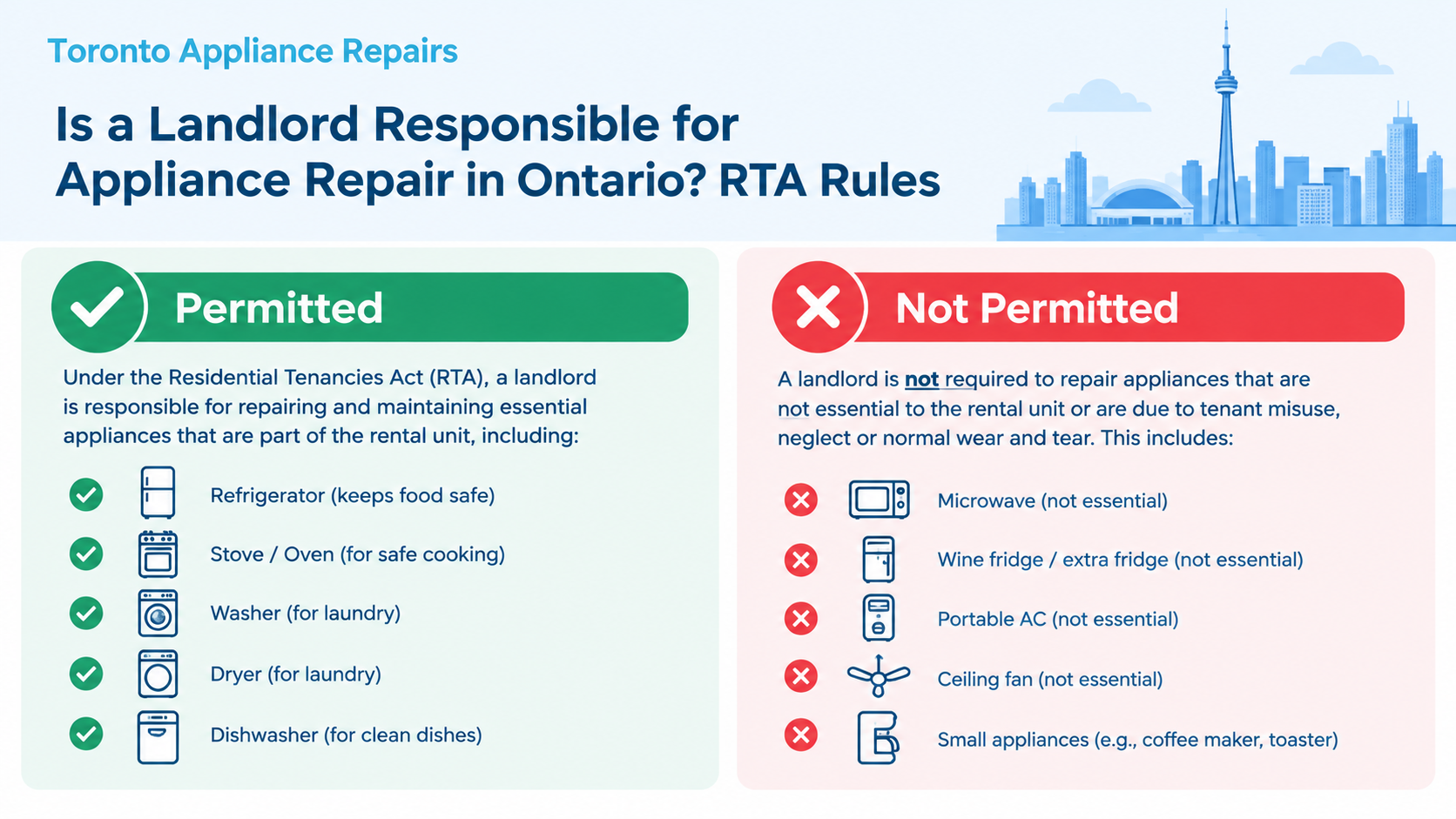
The provision in plain English
The law places the maintenance obligation on the landlord for everything that is part of the rental unit as agreed at the time of signing.
If a landlord advertised a unit as including a fridge, stove, and dishwasher, listed those appliances in the lease, and the tenant moved in on that basis, the landlord accepted responsibility for keeping them in working condition.
A refrigerator not cooling and included in the lease is not the tenant’s problem to pay for.
A washer and dryer the tenant rented and installed themselves is not the landlord’s problem to fix.
The determining factor is whether the landlord supplied the appliance as part of the tenancy. The signed lease is the primary evidence of supply. Ontario’s standard form of lease, mandatory since April 30, 2018, allows landlords to document included services and utilities; appliances are typically listed in the additional terms or an attached schedule.
If an appliance is not documented in the lease or any attached schedule, and there is no other written record showing the landlord supplied it, the question of responsibility becomes harder to resolve. Other written evidence — emails, rental listings, text messages — can still establish that the landlord supplied the appliance even when the lease is silent.
Tenants who discover an appliance missing from their signed lease should request a written amendment before the tenancy begins, or document the landlord’s inclusion of the appliance through email or text messages that establish a clear record.
Common appliance repair issues — refrigerators not cooling, dishwashers not draining, washing machines failing to spin — are all straightforward to resolve when responsibility is clear from the lease.
What is covered under the landlord’s obligation
The landlord’s maintenance and repair obligation applies to:
- Refrigerators, stoves, ranges, and dishwashers that appear on the lease as included in the unit
- Washer and dryer units installed by the landlord inside the rental unit or in a shared laundry room on the property
- Appliances added by the landlord after the tenancy began, documented in a written amendment to the original lease
- Heating systems, hot water heaters, and central HVAC units — these fall under the landlord’s obligation as vital services under the RTA, regardless of what the lease says
- Common area appliances in multi-unit buildings, including shared laundry facilities
- A window air conditioner or portable cooling unit the landlord installed and listed in the lease
Engaging a licensed technician is important for safety during complex repairs, particularly for gas appliances. Verify proper licensing for gas appliance repairs as required by Ontario regulations before any work begins.
What is excluded from the landlord’s obligation
The tenant bears responsibility for:
- Any appliance the tenant purchased, rented, or brought into the unit themselves, regardless of how long it has been in the unit
- Appliances that are not named in the tenancy agreement, even if the landlord verbally agreed they were included at the time of the showing
- Damage the tenant caused to a landlord-owned appliance — through misuse, negligence, or deliberate action
- Appliances in arrangements that do not qualify as residential tenancies under the RTA, including some short-term rentals and owner-occupied shared housing situations
- Minor maintenance tasks that a tenant is reasonably expected to perform, such as cleaning appliance filters, replacing water filters in a fridge, and similar upkeep tasks specifically identified in the lease
Look for warranty coverage on both replacement parts and labour from any repair provider, and request upfront pricing and written estimates before work begins. This protects both tenants and landlords when the cost of a repair is later a point of dispute.
The exclusion most people trip over
The most common mistake tenants make is relying on a verbal agreement or a rental listing instead of the signed lease.
If the landlord said at a showing that the unit “comes with” a fridge and stove but those appliances do not appear anywhere on the signed lease, enforcement at the Landlord and Tenant Board becomes significantly harder.
That said, a T6 application can still succeed with strong supporting evidence — saved text messages, emails, or rental advertisements that clearly state the appliances were included. The absence of a written lease entry is not an automatic bar to a claim, but it does make the outcome less predictable.
The practical lesson: always confirm included appliances in the signed lease before the tenancy begins.
How to check your own case
Check your signed Ontario Standard Form of Lease, including any additional terms pages or attached schedules — if the appliance is named there, or if there is written evidence the landlord supplied it, the landlord is responsible for repairing it.
Coverage table
The question of responsibility comes down to one factor: was the appliance included in the lease?
| Appliance or service | Included in lease | Tenant-owned or not in lease |
|---|---|---|
| Refrigerator | Landlord’s responsibility | Tenant’s responsibility |
| Stove / range | Landlord’s responsibility | Tenant’s responsibility |
| Dishwasher | Landlord’s responsibility | Tenant’s responsibility |
| Washer / dryer (in unit) | Landlord’s responsibility | Tenant’s responsibility |
| Shared building laundry | Always landlord | N/A |
| Heat (September 1 – June 15) | Always landlord | Always landlord |
| Hot water | Always landlord | Always landlord |
| Window air conditioner | Landlord’s if listed in lease | Tenant’s if tenant-installed |
| Gas dryer or stove | Landlord’s if listed in lease | Tenant’s if tenant-installed |
Repair timelines: The RTA does not set a fixed number of days for appliance repairs. “Reasonable time” is the operative standard. Heating and hot water failures are treated as emergencies — same-day or next-day resolution is expected. A broken dishwasher or fridge in a non-emergency situation is generally considered reasonable to resolve within two to seven business days based on LTB case precedent.
For a detailed breakdown of how the repair timeline standard is applied in Ontario, see the guide on landlord repair timelines in Ontario.
Exceptions and edge cases
The RTA’s appliance repair rules are clear in most residential tenancies. A handful of situations create genuine ambiguity.
Subsidized and co-operative housing.
Social housing providers and non-profit housing co-operatives operate under different frameworks. Some fall under the RTA; others are governed by separate legislation or co-op agreements. If you are unsure whether your unit qualifies, the Ontario government’s Landlord and Tenant Board clarifies which tenancies are covered.
Boarding houses and shared owner-occupied rentals.
If you rent a room in a house where the landlord also lives and the two of you share a kitchen or bathroom, modified RTA rules apply. The landlord retains responsibility for common appliances — a shared kitchen fridge or stove — but not for an appliance located exclusively in your private room that you brought yourself.
Post-secondary institution housing.
Students renting from a university or college where the institution itself is the landlord are typically exempt from the RTA if the unit is on or adjacent to the campus. Each post-secondary institution sets its own maintenance and repair rules for residence housing. Students renting from private landlords in Toronto, North York, or Richmond Hill — even within a few blocks of a campus — are covered by the RTA in full and have the same rights as any residential tenant.
Tenant-caused damage.
When a tenant damages an included appliance, the landlord is not obligated to repair it at their own expense. Landlords can serve an N5 notice and file a claim at the LTB for the cost of repair or replacement.
Normal wear and tear — a fridge door seal that has degraded over five years of regular use, for example — remains the landlord’s responsibility regardless of how it presents. The difference between wear and tenant damage is sometimes disputed. A written technician’s report documenting the cause of the fault is the clearest form of evidence for either party. For LG and other major brand diagnostics, Toronto Appliance Repairs technicians can provide a written fault assessment for LTB documentation. See the guide on LG appliance repair faults and costs for LG-specific fault patterns.

What to do next in Ontario
Whether you are a tenant whose landlord has not repaired an included appliance, or a landlord arranging service to stay in compliance with the RTA, the steps below apply across Ontario — including Toronto, North York, Richmond Hill, and Aurora.
Step 1: Put the repair request in writing.
Send an email or a text message with the date, a description of the appliance problem, and a clear request for a repair. Verbal requests are difficult to document at the LTB. A written record establishes a timeline.
Step 2: Give the landlord reasonable time.
Two to seven business days is the standard window for non-emergency faults. For heat or hot water, the window narrows to 24 hours. If the landlord acknowledges the problem and provides a repair date, that is a reasonable response even if it falls at the outer end of the range.
Step 3: Follow up in writing if there is no response.
A second written request, referencing Section 20 of the Residential Tenancies Act, often prompts action. Note that non-payment of rent in response to an unrepaired appliance — without LTB authorization — can expose a tenant to eviction proceedings, even if the underlying complaint is valid.
Step 4: File a T6 application with the LTB if the landlord refuses.
A T6 (Tenant Application about Maintenance) is available at tribunalsontario.ca/ltb. Filing fees apply. The LTB can order the repair, require a rent reduction for the period the appliance was not working, and, in serious cases, award additional remedies.
If you are a landlord arranging timely service to maintain compliance — or a tenant whose landlord has agreed to cover the cost — Toronto Appliance Repairs offers same-day appliance repair across Toronto and the GTA with upfront pricing, no hidden fees, and a written service report suitable for LTB documentation.
For communities north and west of Toronto, appliance repair in Aurora and appliance repair in Barrie cover those areas with the same same-day model and upfront pricing.
Frequently asked questions
Common questions Ontario tenants and landlords ask about appliance repair responsibilities under the RTA.
Is a landlord responsible for appliance repair in Ontario?
Yes, when the appliance is included in the lease. Under Section 20 of the Residential Tenancies Act, Ontario landlords must maintain all included appliances in a good state of repair. If the appliance is not named in the tenancy agreement — or if the tenant brought it themselves — the tenant is responsible for repair costs.
Can a landlord charge a tenant for appliance repair under the ontario government RTA rules?
A landlord can charge a tenant for repairs to an included appliance only when the tenant caused the damage. Normal wear and tear over the tenancy — a fridge seal degrading, a dishwasher pump wearing out after years of regular use — is always the landlord’s cost. Landlords document damage claims and recover costs through the LTB’s N5 process, not by withholding service.
What appliance repair rights do tenants have in north york or richmond hill?
Tenants in North York, Richmond Hill, and all Ontario municipalities covered by the RTA have the same rights as any residential tenant in the province. The Residential Tenancies Act is provincial legislation — it applies uniformly across Ontario. Local bylaws may add minimum maintenance standards on top of the RTA but cannot reduce tenants’ rights below what the Act provides.
How do I find a reliable appliance repair service as a landlord or tenant?
Request upfront pricing and written estimates from any appliance repair service before work begins. Check that technicians are licensed for gas appliance repairs where required, and look for warranty coverage on both parts and labour. Customer reviews on platforms like HomeStars can confirm service quality in your area. Ensure any provider carries insurance to protect against damages during the repair visit.
About Toronto Appliance Repairs
Toronto Appliance Repairs serves Ontario landlords and tenants with same-day appliance repair across Toronto and the GTA, including North York, Richmond Hill, Aurora, Barrie, and surrounding communities.
Licensed technicians handle all major brands — LG, Samsung, Whirlpool, GE, Bosch, KitchenAid, Frigidaire, and Electrolux — and provide written service reports on every visit, which is useful for LTB documentation when repair responsibility is disputed.
Upfront pricing is confirmed before any work begins. No hidden fees. Professional installation services for gas and electric dryers, refrigerators, and other major appliances are also available for landlords preparing a unit for a new tenancy.
Service area
Toronto Appliance Repairs provides appliance repair and installation services across Toronto and surrounding municipalities, including North York, East York, Scarborough, Etobicoke, Mississauga, Richmond Hill, Markham, Aurora, and Barrie.
Contact Toronto Appliance Repairs to confirm same-day availability in your area before booking. Service areas are expanding — call to confirm coverage in communities not listed above.
Next step
Book same-day appliance repair with Toronto Appliance Repairs today.
A technician arrives with the parts most likely needed, diagnoses the fault on the same visit, and confirms a repair quote before any work begins. Written service reports available on request. No hidden fees.
For a full list of appliance repair and installation services across Toronto and surrounding areas, visit Toronto Appliance Repairs services.